

Behind the research, history, and stories
History rarely gives up its secrets easily. Here you’ll find research rabbit holes, folklore, historical curiosities, and occasional glimpses behind the writing desk—from the details that inspire my fiction to the questions that send me searching for answers.
Down the Research Rabbit Hole
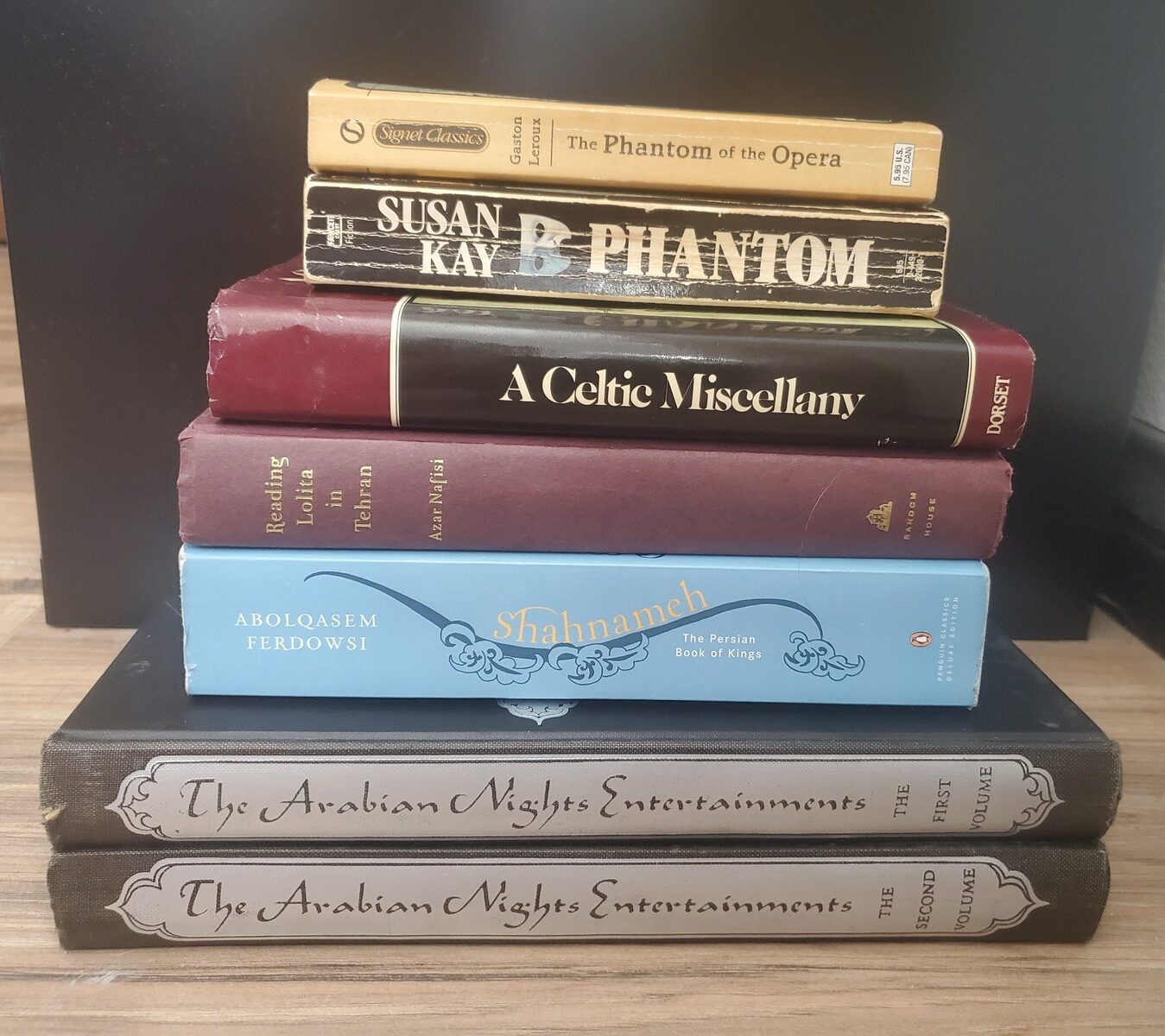
I saw the musical The Phantom of the Opera for the first time when I was thirteen years old with my eighth grade class. I would see it onstage one more time many years later, this time with my dad and my two sisters. From that initial introduction to the elusive, enigmatic Opera Ghost, like most fans, I was hooked. I obsessively listened to the original cast recording. Read and reread the original novel. Read and reread the Susan Kay version, Phantom. This was where the reimagining of the Phantom’s story took shape.
There have been many retellings of the Phantom’s story, and I am sure there will be more in the future. Leroux’s story means different things to different people. For me, it began with a contemplation of the man behind the mask and what had gotten him to Paris in the first place from the far-flung corners of the earth—Persia.
For years, my version of his story lived only in my head. Finally, towards the end of 2021, I decided to put virtual pen to paper and write the story down.
But I had to answer several questions first:
Which Shah of Persia had Erik served?
Who was Malek Khanum?
Who was Mirza Taqi Khan?
What was life like at the court of the Shah of Persia in 1850?
What I discovered was a young monarch at the beginning of an extraordinarily long reign. Nasir al-Din Shah had taken the throne in 1848 at only seventeen years old, and the Persia of his reign would increasingly grapple with modernization, foreign influence, and the competing interests of Russia and Britain.
And then I discovered his prime minister.
Mirza Taqi Khan—better known as Amir Kabir—opened an entirely new rabbit hole.
Mirza Taqi rose from relatively humble beginnings through the Qajar bureaucracy and became a trusted figure in the household of Crown Prince Nasir al-Din. When Mohammad Shah died in 1848, Mirza Taqi played an instrumental role in securing the seventeen-year-old prince’s succession. The new shah appointed him chief minister and bestowed upon him the title Amir Kabir. He later married the shah’s sister, Ezzat al-Dowleh.
In his new role, Mirza Taqi slashed excessive government spending, sanctioned public projects such as the bazaar in Tehran and a secular college, and curtailed foreign interference in Iranian domestic affairs.
However, Mirza Taqi Khan drew the disdain of Malek Khanum—Mahd-e Olya—Nasir al-Din Shah’s mother.
And this was where my research started getting really interesting.
Malek Khanum was no passive queen mother. Known by the title Mahd-e Olya, she wielded considerable influence within the royal household and became one of Amir Kabir’s most formidable enemies.
Suddenly, the court I was researching wasn’t simply a backdrop. It had personalities. Alliances. Rivalries. People who loved one another, hated one another, manipulated one another, and competed for the ear of a very young shah.
Susan Kay’s version of the Khanum gave me some material to work with. In Phantom, Erik’s interactions with the queen mother were mostly cold and commanding, their relationship defined by power and obedience. But I wanted the other women of the court to have three dimensions, and that meant understanding what daily life within the royal harem might actually have been like.
It was far more complicated than the Western image of a secluded world filled with music, jewels, and idle luxury. The harem was a household with its own hierarchy, relationships, rivalries, and politics. Women cultivated accomplishments in music, poetry, embroidery, and art, while a woman’s position could be profoundly affected by her relationship with the shah and by the status of her children. His favor could mean greater comfort, influence, and security in a world where women otherwise possessed limited formal political power.
But knowing who lived there still didn’t tell me what living there looked like.
I stumbled across a subtitled Turkish drama, Magnificent Century. The series follows Sultan Süleyman I and Hürrem Sultan, known in European sources as Roxelana. Born somewhere in Eastern Europe and enslaved before entering the imperial harem, Hürrem eventually became Süleyman’s consort and, extraordinarily, his legal wife. She would become one of the most influential women in Ottoman history.
Sixteenth-century Ottoman Constantinople was, of course, not nineteenth-century Qajar Tehran, and I didn’t use the series as a source for Persian court customs. What it gave me was something different: a way to visualize the human dynamics of an imperial household.
Watching this show inspired the relationships I created between the women of the shah’s harem in The Magician’s Witch. Now, throw in a modern-day western woman with supernatural powers, and sparks begin to fly…
And all of this began with one seemingly simple question: Which Shah of Persia had Erik served?
That’s the trouble with historical research. One answer inevitably leads to another question, another book, another obscure corner of the internet—and another rabbit hole waiting to be explored.
https://phantomstheater.weebly.com/Persia-and-the-Shah.html#Shah